The challenge
Connect two prepared paper cups with string and compare a short spoken phrase with the string taut and slack. The minute covers threading, securing the second end and making one comparison. Piercing the cups, cutting string and arranging the test area are preparation. You will need a willing partner, not a hidden recording or a dramatic shout.
This is a familiar-object transformation rather than an impossible effect. Its puzzle is to identify which condition helps the message travel. Results depend on the cups, string, room and technique. If you mostly hear the person through the air, that is a reason to improve the comparison, not to claim the device worked.

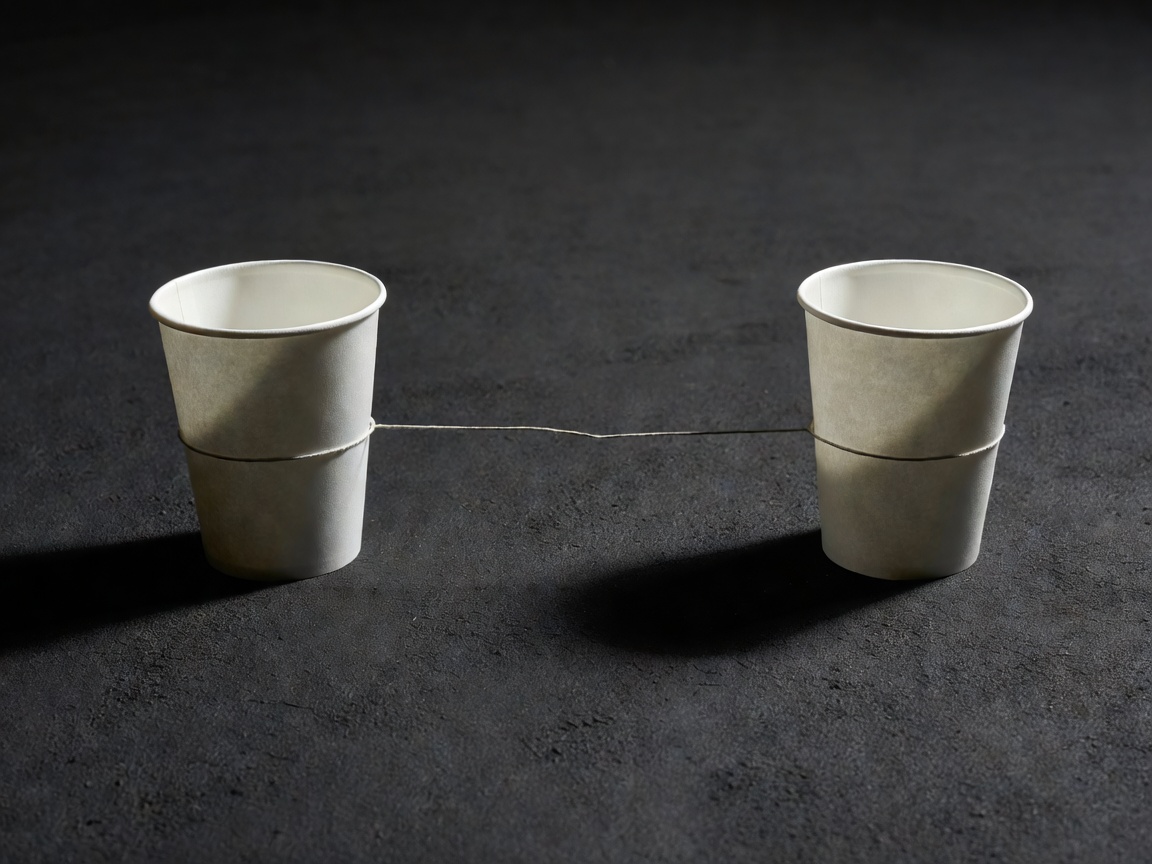
Preparation, outside the minute
- Two clean, dry paper cups with intact bases.
- About 2 metres of smooth cotton string.
- Two small pieces of tape and adult help for making holes.
- A quiet, clear area and a partner who agrees to take part.
An adult should make one small hole in the centre of each cup base using an appropriate tool on a protected surface. Keep sharp tools out of the timed attempt. The hole should admit the string but not a securing knot. Prepare one string end through the first cup and tie a substantial knot inside; cover it with a small tape patch if needed.
Leave the second cup unattached for the challenge. Lay the loose string out so it cannot catch feet or furniture. Never wrap string around a neck, wrist or body, and never stretch it across a walkway. Do not use glass, metal cans with sharp edges or any setup that requires pulling hard.
Your timed attempt
- Complete the connection. Thread the free end through the second cup from outside to inside. Tie a knot large enough to stay inside, then add the prepared tape patch.
- Take your positions. Each person holds a cup. Move apart slowly until the string is gently taut, without crushing the bases.
- Try a quiet phrase. One person speaks softly into a cup while the other holds the open rim near, not pressed against, an ear.
- Change one condition. Bring the cups slightly closer so the string goes slack. Repeat the same phrase at a similar volume.
Partner and space ready?
Ready when your preparation is complete.
Listen for the difference
Use a short phrase such as “paper makes a message.” Avoid shouting: that makes direct airborne sound dominate and can be uncomfortable for the listener. Keep the string clear of furniture and fingers during the taut trial. Contact can damp the vibrations and change the result.
If tying the knot takes the entire minute, stop the clock and finish without rushing. Call that an assembly attempt, then run a separate untimed sound comparison. The challenge is allowed to reveal that a task is fiddlier than expected. It does not need an edited finish to count as worthwhile.
Reveal what carries the message
Your voice makes the first cup’s base vibrate. A gently tensioned string can transmit those mechanical vibrations to the second cup, whose base moves and sets nearby air vibrating. Slack string usually couples the motion less effectively in this simple setup.
You may still hear your partner directly through the air. To distinguish the effect, keep voice level and distance as similar as practical, and compare repeated taut and slack trials. A difference is evidence about this setup, not a calibrated measurement of sound quality.
Why the object transformation works
The cups have not gained electronics. Their job has changed because you connected a vibrating surface to another vibrating surface. This is the same broad physical world studied in acoustics, though a paper-cup model is much simpler than a telephone system. Alexander Graham Bell’s electrical telephone is a different technology, not the mechanism operating here.
For wider context, the Exploratorium explores hands-on sound phenomena, and the Science Museum has resources on communication technology. The National Institute on Deafness and Other Communication Disorders provides information about hearing. These organizations are independent references, not partners or endorsers.
A clever transformation changes the job, not the truth about the object.
Try a careful second comparison
After the timed round, compare a different string while keeping the cups, distance and phrase unchanged. Do not assume that thicker, longer or tighter always means better. Write down what you actually heard, including uncertain results. With permission, ask your partner to choose phrases you cannot predict to reduce the chance that you are simply filling in familiar words.
When sharing, label any boosted audio or replacement sound. Show the prepared holes and explain that string cutting happened earlier. This makes a satisfying transformation reproducible: two ordinary objects, a clear connection and a small experiment anyone can question.