The challenge
Arrange six prepared paper walls on a small base to create a route from START to FINISH, with at least one junction and one dead end. Slide a flat paper counter along the route to check it. Your one minute covers arranging, attaching and testing. Cutting strips, folding feet and preparing tape happen before the clock.
This is a maze-design challenge, not a miniature woodworking project. You do not need hot glue, a craft knife or a rolling marble. A large paper counter is easier to retrieve and less likely to disappear under furniture. Small parts still need sensible handling around children and pets.
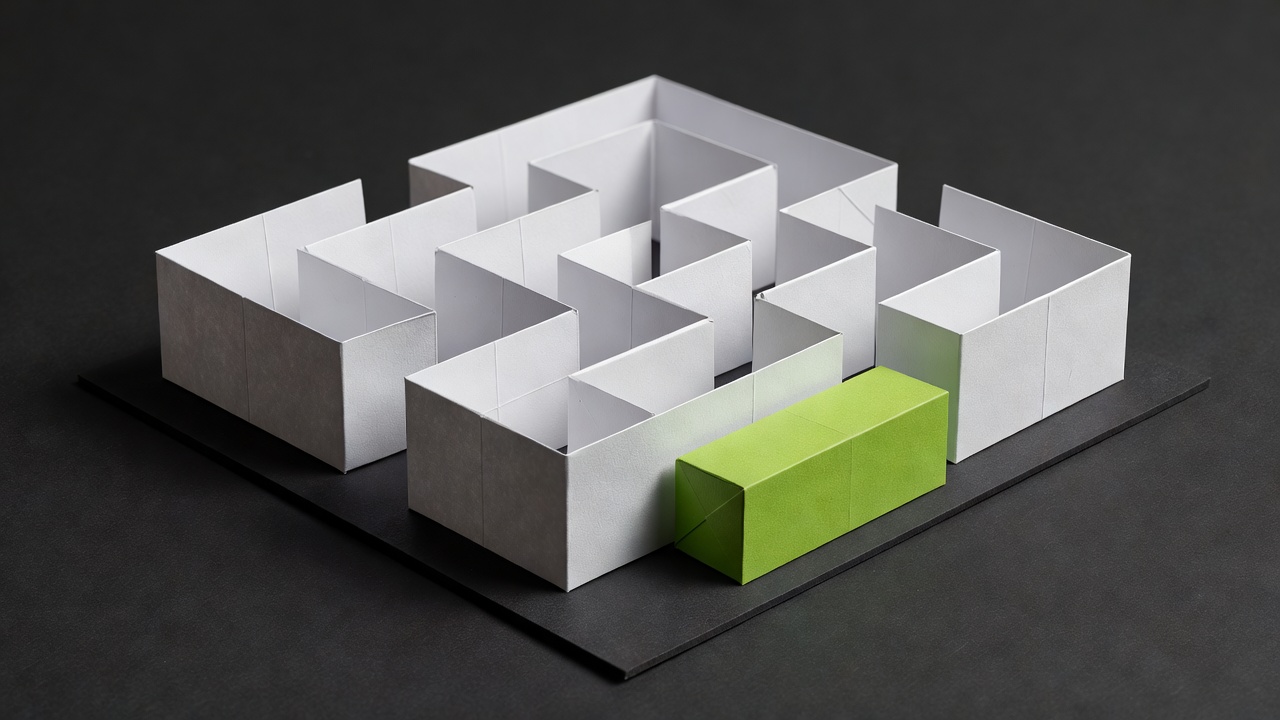
Preparation, outside the minute
- A roughly 15 cm square piece of reused card.
- Six paper strips, each about 5 cm long and 2 cm wide.
- Six small tape tabs and a pencil.
- A flat paper counter about 2 cm across.
Fold a narrow foot along one long edge of every strip so each wall can stand. Attach a tape tab to each foot, leaving it ready to press down. Test that the tape releases without tearing your base; removable tape is useful when you want to rebuild. Make all cutting and folding part of the disclosed preparation.
Mark START near one corner and FINISH near the opposite corner. Draw a light perimeter line and agree that the counter cannot leave it. This creates a boundary without needing extra walls. Before starting, measure the counter against your intended passages: every route must be wider than the counter, with a little clearance.
Your timed attempt
- Reserve a route. Picture a broad, bent corridor connecting START and FINISH before placing anything.
- Add the first barriers. Use several walls to interrupt the direct path while leaving the reserved route open.
- Create a choice. Arrange a side passage that branches off the good route and ends at a wall. Make the entrance wide enough to look genuinely usable.
- Test the counter. Slide it from START to FINISH without crossing walls, jumping gaps or leaving the perimeter. Then visit the dead end to verify it really stops.
Walls prepared?
Ready when your preparation is complete.
Check the rules, not the decoration
A winding corridor can look impressive but offer no decisions. For this challenge, a solver must encounter at least one place with two plausible ways forward. One branch should eventually fail while another reaches FINISH. Colour, tiny flags and extra scenery are optional additions after the timed attempt.
Watch for accidental shortcuts. A gap beside a wall counts as a route if the counter fits through it under your rules. Decide before testing whether the counter can rotate; allowing rotation may open a passage you expected to block. Consistent movement rules make a small puzzle feel fair.
Reveal a reliable design method
Work backwards from a guaranteed solution. Imagine an S-shaped corridor, then place walls beside it without closing it. At one bend, leave an opening into a short side corridor and block that corridor’s far end. You now have a route plus a deliberate dead end.
Check connectivity by tracing every passage with a pencil tip before moving the counter. If START cannot reach FINISH, move one barrier rather than rebuilding everything. There is no single mandatory layout; success is defined by the route, junction, dead end and movement rules.
The small idea behind big mazes
Mathematically, you can represent junctions and dead ends as vertices of a graph, with passages as edges. The physical size of the model does not change that basic relationship. Leonhard Euler’s work on the Seven Bridges of Königsberg is a famous early connection between routes and graph theory, although that bridge problem asks a different question from this maze.
A maze usually offers branching choices, while a classical labyrinth often has one continuous route. Hampton Court Palace is known for its hedge maze; the floor labyrinth at Chartres Cathedral illustrates the contrasting single-route idea. These are useful comparisons, not templates you need to reproduce in a minute.
A tiny maze becomes a puzzle when the route asks a question.
A fair second round
Give the finished model to someone who did not watch you assemble it. Let them inspect the rules before timing any solve. If they finish immediately, your maze still works; short does not mean defective. Ask where they made their decision rather than trying to trap them with an invisible rule.
For a repeat attempt, keep the same six walls and move only one. Predict whether the change creates a shortcut, closes the solution or adds another dead end. Photograph the before and after from the same overhead angle so the transformation is clear. Honest, comparable views are more useful than a dramatic close-up that hides half the route.