The challenge
Cut around the centre of a prepared paper loop and predict how many separate pieces you will finish with. The loop has one half twist before its ends are joined. Your timed minute includes stating your prediction, following the centre route and opening the result. Making the starting strip is preparation, not a hidden part of the performance.
This challenge uses scissors. It is not a speed-cutting contest. An adult should prepare and supervise cutting for children who need help, and anyone uncomfortable with scissors can run the prediction while another person cuts without a timer. The interesting part is the change in understanding, not the quickest blade.
Preparation, outside the minute
- A paper strip approximately 3 cm wide and 25–30 cm long.
- A short piece of clear tape, a pencil and suitable scissors.
- A clear work surface and an optional untwisted comparison loop.
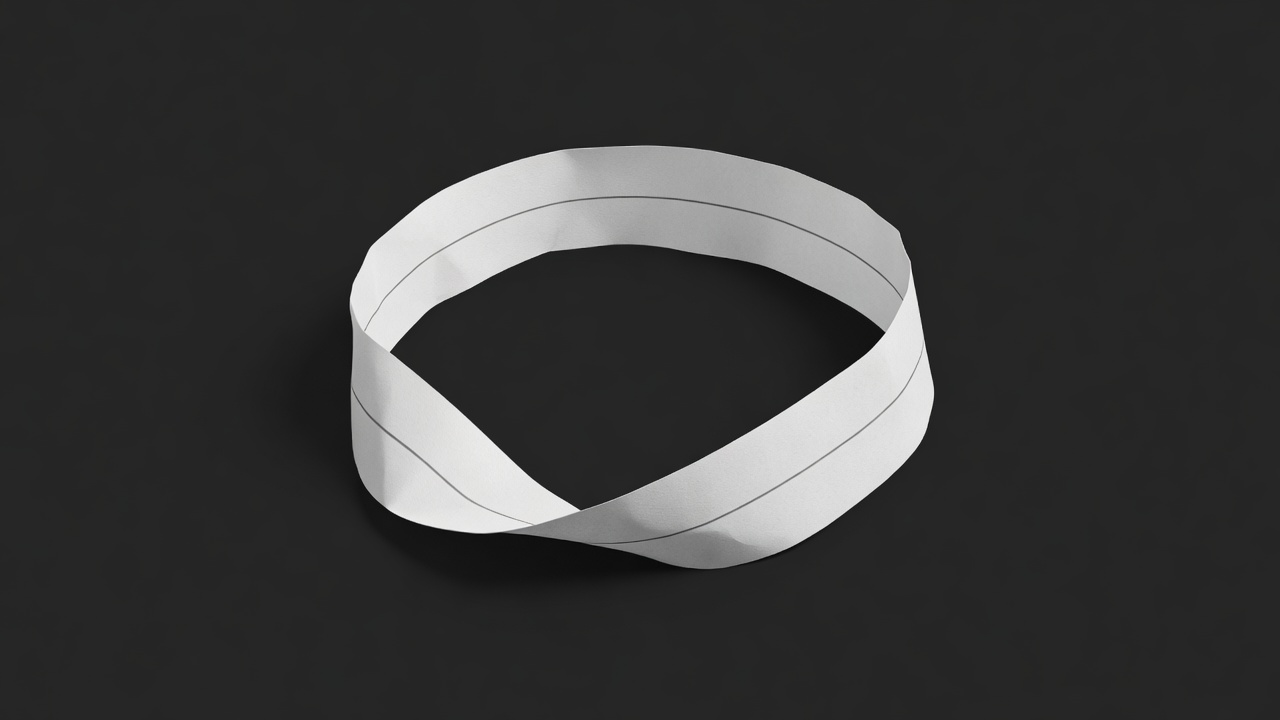
Bring the two short ends towards each other. Rotate one end through a half turn, then tape the ends together securely. Keep the tape small and flat so it does not obstruct the scissors. Check that the loop contains one half twist rather than a full turn. A full turn makes a different starting object.
Draw a pencil path along the centre of the strip, continuing around until it meets itself. That route helps you stay away from the edges. An adult can make a small starter opening on the centre line before the clock begins. Do not force a scissor point through a loop held in your hand.
Your timed attempt
- Say the prediction. One loop, two loops, or something else? Commit before cutting.
- Follow the centre. Enter through the prepared opening and cut steadily along the pencil route. Rotate the paper, not your wrist into an awkward angle.
- Finish the route. Continue until you meet the starting cut. Stop the timer early if the paper tangles or the scissors snag.
- Open the result gently. Lay it on the table and count separate closed pieces without tearing any joins.
Prediction ready?
Ready when your preparation is complete.
Look before you read
Do not pull the paper taut to make the result resemble an illustration. A loop can lie in many shapes without becoming a different object. Instead, trace one edge with your finger and check whether any piece is actually separate. If your cut wandered into an outer edge, record that as a cutting error and prepare a fresh strip.
Reveal what the centre cut does
A correctly made Möbius strip cut along its centre becomes one longer loop, not two separate loops. The resulting band has a full twist and is no longer a Möbius strip. The surprising result comes from how the original half twist joins the two halves of your cutting route.
For comparison, an untwisted paper loop cut along its centre becomes two separate loops. The scissors perform a similar-looking action, but the initial connection is different. A single changed condition produces a different outcome.
Why this is geometry, not a secret move
A Möbius strip is a classic example from topology, the study of properties preserved through continuous deformation without tearing or gluing. The ideal mathematical surface has one side and one boundary. Real paper has thickness, but a thin paper model gives a useful, tangible approximation.
August Ferdinand Möbius and Johann Benedict Listing independently described this surface in 1858. You do not need their mathematics to enjoy the prediction, but naming the object makes it easier to explore further. The Millennium Mathematics Project and the National Museum of Mathematics offer broader routes into hands-on mathematical thinking.
A fair trick lets the viewer inspect the starting conditions.
Share the surprise honestly
Show the half twist before the tape closes the loop. Keep the strip in view while cutting, or clearly label any edit. A reaction clip can be entertaining without claiming that paper broke the laws of nature. If you practiced first, say so; practice is preparation, not evidence that everyone will finish at the same pace.
For another round, make an untwisted loop and repeat the same centre cut. Predict first again. Avoid adding more complicated cuts until you can explain both starting cases. One clean comparison is more satisfying than several tangled strips and an explanation that depends on hand-waving.